
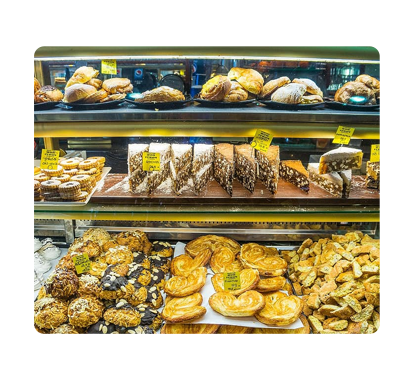
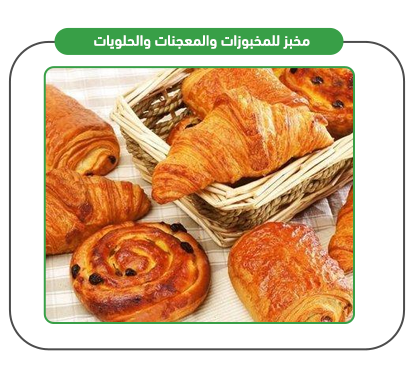
Bakery for baked goods, pastries and sweets

Study request

It is about establishing a bakery to produce pastries, baked goods and sweets to benefit from the availability of high-quality raw materials at reasonable prices and with the aim of obtaining a major share in the market and achieving benefit from several economic and marketing opportunities by using the best means of technology with the highest specifications and the best levels of quality so that it can compete with local producers in order to meet the demand and the increasing volume of consumption of the product as it is a product with many uses and represents the largest use in the individual, restaurant and hospital sectors

share capital

Rate of return

Recovery period Second year

Project Description

Project Description

It is about establishing a bakery to produce pastries, baked goods and sweets to benefit from the availability of high-quality raw materials at reasonable prices and with the aim of obtaining a major share in the market and achieving benefit from several economic and marketing opportunities by using the best means of technology with the highest specifications and the best levels of quality so that it can compete with local producers in order to meet the demand and increasing consumption of the product as it is a product with many uses and represents the largest use in the individual, restaurant and hospital sectors. The bakery project targets many target sectors such as hotels, restaurants, embassies, fast food restaurants, supermarkets, sports clubs. Police clubs, armed forces, security services, wedding and event halls, when holding festivals, women’s associations and consumers who prefer to obtain these products fresh and directly from the producers to present them to their visitors during banquets. Consumers during family trips. Consumers during Eid al-Fitr and Eid al-Adha.

Project Products

Project Products

  • Arabic bread
  • Shabura
  • small piece cake
  • cupcake
  • Swiss roll
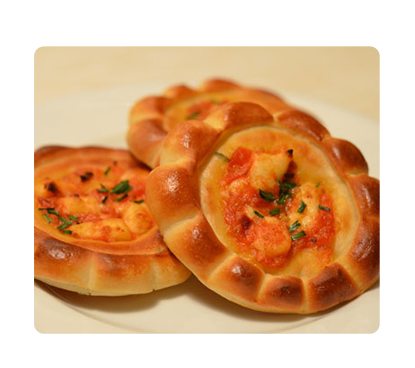
  • Thyme pastries
  • Pastries with thyme and cheese
  • Cheese pastries
  • Regular donut
  • Chocolate donut
  • Croissant with cheese
  • Croissant with cheese and thyme
  • Date Maamoul
Why Mashroo3k ?

Why Mashroo3k ?

  • Mashroo3k has over 11 years of experience in preparing feasibility studies, conducting market research, and providing comprehensive consulting services.
  • Mashroo3k has offices in 7 international branches, located in Saudi Arabia, the UAE, Egypt, Qatar, Oman, Yemen, and Iraq, in addition to its agents in China, Singapore, and other countries.
    Having delivered over 7,000 feasibility studies, Mashroo3k has helped thousands of clients achieve their investment goals.
  • Mashroo3k’s services are accredited and trusted by all financial institutions and funding entities across the Middle East.
  • The company’s geographic reach spans 35 countries across all continents.
  • Mashroo3k holds membership in over 100 prestigious international organizations specializing in market research and business management.
  • Its team consists of 350 consultants with deep expertise in promising economic sectors, ensuring tailored solutions and strategies that meet clients’ needs.
  • Mashroo3k is partnered with more than 10,200 suppliers across 22 countries, providing logistical support for projects, including production lines, raw materials, machinery, and equipment.
  • With an extensive database, Mashroo3k enhances the accuracy of its forecasts and analyses, strengthening its risk management capabilities.
  • Project features
  • Study Contents
  • Sector Indicator
  • The project as an investment opportunity
مؤشرات القطاع
  • Use of technology:
  • Availability of specialized technical cadres.
  • Management at the highest level of expertise
  • Highly qualified and experienced workers
  • Control of product quality and operational process
  • Having a strong and integrated advertising plan.

Executive Summary

  • About the project
  • Financial indicators
  • Justifications for establishing the project
  • Government investment incentives in the project field
  • Target Markets
  • Project indicators and final results

Study of project services/products

  • Study of project services/products
  • Description of the project and all its products/services

Market Size Study

  • Familiarity with distribution channels
  • Consumer behavior, desires and nature
  • Competitors’ products or services, and what their strengths and weaknesses are.
  • Nature of the market and its characteristics
  • The volume of demand for the product or service provided
  • Available share of target market
  • The best way to market

Risk study

  • Identify risks
  • Impact of risks on the project
  • Risk prevention methods

Technical study

  • Detailed description of project products Expected production capacity Determination of investment costs
  • Determine the volume of electrical energy and water
  • Determine the project’s labor needs
  • Determine project requirements
  • Construction and building cost calculation
  • Total Capital Calculation
  • Determine annual operating costs
  • Determine the amount of working capital

Financial study

  • Total investment costs required for the project
  • Organizing the cash flow and income statements as well as the financial position statement for the first ten years of operation.
  • Determine the expected annual revenues of the project in light of the specified operational capacities.
  • The optimal financing structure for the project in light of the investors’ capabilities and in light of the financing granting conditions
  • Project financial indicators and sensitivity analysis

Organizational and administrative study

  • Project manpower
  • Organizational structure
  • Job Duties
المشروع كفرصة استثمارية

Food & Beverage Sector in the GCC

The GCC countries account for only 0.7% of the world’s population, yet they represent 3% of global spending on processed food and beverages, amounting to $102 billion out of $3.4 trillion globally. This reflects a high per capita food consumption in the region, exceeding the global average.

Key Demographic Drivers

  • Total GCC population: 58 million
  • Age group (25-54 years): 56.3% – This segment drives the food industry due to its economic activity and consumption habits.

Since Saudi Arabia comprises 59.7% of the total GCC population and holds 53% of the GCC food & beverage market, we highlight key indicators for this vital sector in the Kingdom.

Food & Beverage Sector in Saudi Arabia

Manufacturing & Market Value

  • Total food product factories: 916 (with 249 under construction)
  • Total beverage factories: 209 (with 71 under construction)
  • Food factories account for 11.1% of all manufacturing plants (8,258 factories)
  • Beverage factories account for 2.5% of total manufacturing

Market Size & Consumption Trends

  • Saudi food & beverage market value: SAR 168.8 billion
  • Total food consumption (2021): SAR 221 billion (6% growth)
  • Saudi Arabia’s food consumption value: $70 billion (60% of GCC total)
  • Fast food market forecast: $4.5 billion in the next 3 years
  • Organic, health, and specialty food market: $27 billion
  • Halal food market size: $6 billion
  • Annual food & beverage imports: $14.5 billion

Operational Expenses & Revenue Growth

  • Food service sector expenses (2020): SAR 34.03 billion (up from SAR 30.07 billion in 2018)
  • Food service sector revenue (2020): SAR 61.56 billion (up from SAR 54.87 billion in 2018)
  • Projected operational expenses (2027): SAR 52.49 billion
  • Projected revenue (2027): SAR 92.08 billion
  • Projected total revenue from food manufacturing (2027): SAR 128.54 billion

Global Food Sector Overview

Key Challenges & Production Figures

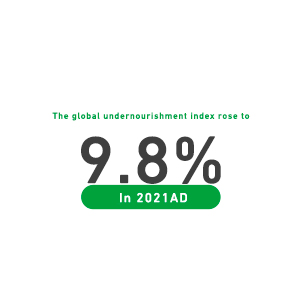
  • Global malnutrition rate (UNICEF, 2021): 9.8%
  • People suffering from hunger: 702 – 828 million
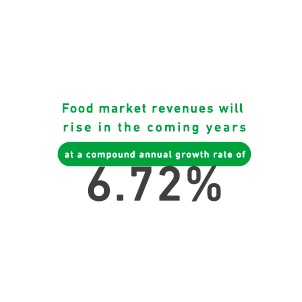
  • Global food market revenue: $8.66 trillion
  • Online food sales share: 7.8% of total revenue

Global Agricultural Production

  • Total crop production: 9.4 billion tons
  • Meat production: 337 million tons
  • Fruit production: 883 million tons
  • Vegetable production: 1,128 million tons
  • Vegetable oil production: 201 million tons
  • Dairy production: 883 million tons
  • Egg production: 83 million tons

The GCC’s food and beverage industry is one of the most dynamic sectors, driven by high consumption rates, increasing demand for organic and halal products, and rapid market expansion. Saudi Arabia, as the largest market in the region, presents significant investment opportunities in both manufacturing and retail food sectors.
مؤشرات المشروع
  • The fast food market in Saudi Arabia is expected to reach $4.5 billion in the next three years.
  • The size of the organic, healthy and specialty food market in the Kingdom is $27 billion, and the size of the halal food products market is $6 billion.
  • The Kingdom of Saudi Arabia’s imports of food and beverages are estimated at $14.5 billion each year.
  • In 2020, operating expenses for food and beverage services activities were estimated at about 34,032.10 million riyals, noting that these expenses did not exceed 30,069.23 million riyals in 2018.
  • As for operating revenues for food and beverage services activities, their value was estimated at about 61,557.77 million riyals in 2020, noting that the value of these revenues did not exceed 54,866.87 million riyals in 2018.
  • The value of operating expenses for food and beverage services activities is expected to reach 52,489.34 million riyals in 2027. The operating revenues of the same activities are expected to reach 92,084.64 million riyals (2027). 128,540,573 thousand riyals is the total expected operating revenues in 2027 for the food products industry in the Kingdom of Saudi Arabia.

By sector


share capital(By the million)


Rate of return


  • Similar projects

Similar projects

Women’s coffee shop

share capital

Rate of return

Study request

Baby supplies store project

share capital

Rate of return

Study request

Bakery and sweets shop

share capital

Rate of return

Study request