Children’s library

Study request

Mashroo3k Economic Consulting Company offers a feasibility study for a multi-service children’s library project in Iraq, with the best return on investment and the best payback period, through accurate studies of the size of the Iraqi market, analysis of competitors’ strategies, and submission of competitive price offers.

share capital

Rate of return

Recovery period Second year

Children's Library Project Description

Children’s Library Project Description

Through the Children’s Library Project, Mashroo3k Economic Consulting Company provides an investment opportunity in Iraq. The project targets children from various backgrounds, and provides, in addition to various books, educational, teaching, and cultural services in various scientific, religious, literary, and artistic fields. To develop the child’s mental and creative abilities, and to develop reading and writing skills.

Mashroo3k Economic Consulting Company provides investors wishing to invest in a children’s library project in Iraq with a set of specialized feasibility studies based on updated databases specific to the Iraqi market, which helps the project succeed and achieve the best return on investment.

Children's Library Services

Children’s Library Services

  • Young Muslim books for all age groups.
  • Adventure stories and wonders of the world.
  • Stories of prophets and figures of Islamic history.
  • Stories of anecdotes and riddles.
  • Science fiction stories and innovations for all age groups.
  • Periodic publications of Arabic and foreign children’s magazines.
  • Coloring books and teaching letters and numbers.
  • Educational books for children.
  • Puzzles and cut and paste drawings
  • Educational tools and posters of cartoon characters.

Mashroo3k Economic Consulting Company is keen to provide the best services for developing children’s creative skills in a successful children’s library project, through the latest creative learning programs in the world, and other services that Mashroo3k consultants are keen to provide in the children’s library project, to help investors determine the best ways and methods to develop the project’s services and raise its competitive advantages.

Why Mashroo3k ?

Why Mashroo3k ?

  • Mashroo3k has over 11 years of experience in preparing feasibility studies, conducting market research, and providing comprehensive consulting services.
  • Mashroo3k has offices in 7 international branches, located in Saudi Arabia, the UAE, Egypt, Qatar, Oman, Yemen, and Iraq, in addition to its agents in China, Singapore, and other countries.
    Having delivered over 7,000 feasibility studies, Mashroo3k has helped thousands of clients achieve their investment goals.
  • Mashroo3k’s services are accredited and trusted by all financial institutions and funding entities across the Middle East.
  • The company’s geographic reach spans 35 countries across all continents.
  • Mashroo3k holds membership in over 100 prestigious international organizations specializing in market research and business management.
  • Its team consists of 350 consultants with deep expertise in promising economic sectors, ensuring tailored solutions and strategies that meet clients’ needs.
  • Mashroo3k is partnered with more than 10,200 suppliers across 22 countries, providing logistical support for projects, including production lines, raw materials, machinery, and equipment.
  • With an extensive database, Mashroo3k enhances the accuracy of its forecasts and analyses, strengthening its risk management capabilities.
  • Project Features
  • Study Contents
  • Sector Indicator
  • The Project is an Investment Opportunity
مؤشرات القطاع
  • Availability of the most enjoyable types of stories for children
  • The presence of a management with a high interest in the project
  • Good communication with customers and knowing their desires
  • Organization and sophistication in the process of displaying and arranging stories
  • Attention to general cleaning work of the place from the outside and inside
  • Expanding the child’s reading awareness.
  • Facilitating the child’s access to information.
  • Gaining the child new interests.
  • Preparing the child to deal with sound social institutions.
  • Providing sources of information appropriate to the child’s needs, desires and inclinations.
  • Developing the child’s social awareness and helping him practice a sound social life.
  • Discovering the child’s true inclinations, latent readiness and effective abilities.

Executive Summary

  • About the project
  • Financial indicators
  • Justifications for establishing the project
  • Government investment incentives in the project field
  • Target Markets
  • Project indicators and final results

Study of project services/products

  • Study of project services/products
  • Description of the project and all its products/services

Market Size Study

  • Familiarity with distribution channels
  • Consumer behavior, desires and nature
  • Competitors’ products or services, and what their strengths and weaknesses are.
  • Nature of the market and its characteristics
  • The volume of demand for the product or service provided
  • Available share of target market
  • The best way to market

Risk study

  • Identify risks
  • Impact of risks on the project
  • Risk prevention methods

Technical study

  • Detailed description of project products Expected production capacity Determination of investment costs
  • Determine the volume of electrical energy and water
  • Determine the project’s labor needs
  • Determine project requirements
  • Construction and building cost calculation
  • Total Capital Calculation
  • Determine annual operating costs
  • Determine the amount of working capital

Financial study

  • Total investment costs required for the project
  • Organizing the cash flow and income statements as well as the financial position statement for the first ten years of operation.
  • Determine the expected annual revenues of the project in light of the specified operational capacities.
  • The optimal financing structure for the project in light of the investors’ capabilities and in light of the financing granting conditions
  • Project financial indicators and sensitivity analysis

Organizational and administrative study

  • Project manpower
  • Organizational structure
  • Job Duties
المشروع كفرصة استثمارية

The Service Sector in the Gulf Cooperation Council (GCC) Countries

According to macroeconomic sector theory, the economy is divided into three main sectors:

  1. The Primary Sector: This sector is based on the collection of raw materials and includes mining companies, timber companies, oil exploration companies, as well as agricultural industries and fishing.
  2. The Secondary Sector: This sector relies on goods and their sale, such as the automobile industry, furniture manufacturing, and clothing trade, among others.
  3. The Tertiary Sector (Services): This sector is responsible for providing and producing services, relying primarily on intangible elements, such as entertainment, healthcare, transportation, hospitality, restaurants, and more. This theory posits that as countries develop, their economies become more reliant on the service sector, in contrast to primitive economies that primarily depend on the primary sector. For example, in the United States, the service sector constitutes 85% of its total economy.

Saudi Arabia:

The service sector is a major sector in Saudi Arabia, encompassing:

  • Wholesale and retail trade, restaurants, and hotels.
  • Transport, storage, information, and communications.
  • Financial services, insurance, real estate, and business services.
  • Community, social, and personal services.
  • Government services.

Key indicators of the sector in Saudi Arabia:

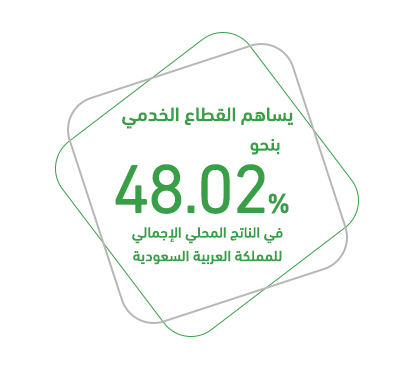
  • The service sector contributes 48.2% to the country’s GDP.
  • Wholesale, retail trade, restaurants, and hotels contribute 10.8% to GDP.
  • Transport, storage, information, and communications contribute 6.6% to GDP.
  • Financial services, insurance, real estate, and business services contribute 6.4% to GDP.
  • Community, social, and personal services contribute 2.5% to GDP.
  • Government services contribute 21.9% to GDP.
  • In the past year, 100,944 new business licenses were issued in Saudi Arabia, bringing the total to 348,173 licenses.
  • The wholesale and retail trade sector, including motor vehicle and motorcycle repair, accounted for 48,242 licenses, followed by accommodation and food services with 16,531 licenses, and construction with 11,521 licenses.

Qatar:

  • The wholesale and retail trade sector in Qatar is valued at 50,083 million Qatari riyals.
  • The number of establishments operating in wholesale and retail trade: 11,139.
  • The number of employees in this sector: 213,954.
  • Total compensation for employees in this sector: 11,288,877 thousand Qatari riyals.
  • Establishments in the hospitality and restaurant sector: 2,396.
  • Number of employees in hospitality and restaurants: 78,194.
  • Compensation for hospitality and restaurant workers: 2,947,431 thousand Qatari riyals.
  • Mobile phone subscribers (regular plans): 976,015.
  • Prepaid mobile phone subscribers: 2,941,556.
  • Roads paved in the past year: 2,224 km.
  • New driver’s licenses issued: 242,923.
  • Compensation for workers in the transport and communications sector: 24,338,223 thousand Qatari riyals.
  • Number of insurance documents issued: 715,897.
  • Number of business services establishments: 4,973.
  • Number of employees in business services: 215,285.
  • Compensation for workers in business services: 15,347,819 thousand Qatari riyals.
  • Private sector employees in social and personal services: 80,569.
  • Compensation for workers in social and personal services: 6,127,645 thousand Qatari riyals.

Kuwait:

  • Wholesale and retail trade contribute 1,644.3 million Kuwaiti dinars to GDP.
  • The restaurant and hotel sector contributes 418.6 million Kuwaiti dinars to GDP.
  • Transport, storage, and communications contribute 2,554.5 million Kuwaiti dinars.
  • Total paved roads: 91,340,068 square meters.

United Arab Emirates (UAE):

  • Wholesale and retail trade, including motor vehicle and motorcycle repair, contribute 12.3% to GDP (172,288 million dirhams).
  • Transport and storage contribute 5.9% to GDP (82,461 million dirhams).
  • Accommodation and food services contribute 2.3% to GDP (32,357 million dirhams).
  • Information and communications contribute 2.9% to GDP (41,347 million dirhams).
  • Financial and insurance activities contribute 9.6% to GDP (134,773 million dirhams).
  • Number of insurance policies issued: 7,584,607.
  • Wholesale and retail trade employs 13% of the total workforce.
  • Transport and storage employ 6.2% of the total workforce.
  • Accommodation and food services employ 5% of the total workforce.Oman:
  • Oman’s GDP: 29.3 billion Omani rials.
  • Wholesale and retail trade contribute 7% to GDP (2,064.7 million Omani rials).
  • Restaurants and hotels contribute 1.1% to GDP (308.6 million Omani rials).
  • Transport, storage, and communications contribute 5.9% to GDP (1,721.2 million Omani rials).

Global Service Sector:

The service sector is the largest contributor to global GDP, accounting for more than three-fifths of total economic output. Unlike manufacturing sectors that produce tangible goods like automobiles and furniture, the service sector is based on intangible services such as banking, healthcare, transportation, hospitality, and entertainment.

  • The market value of the global service sector was $10,814.49 billion in 2020.
  • By 2021, this value increased to $11,780.11 billion, achieving a compound annual growth rate (CAGR) of 8.9%.
  • After recovering from the COVID-19 pandemic, global market experts predict the sector will reach $15,683.84 billion by 2025.
  • The service sector is expected to grow at a CAGR of 7% in the coming years.

This data underscores the importance of the service sector both globally and within the GCC, making it a crucial area for economic growth and investment.

مؤشرات المشروع

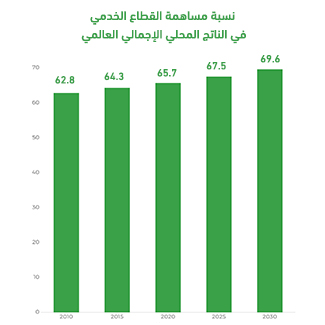
Mashroo3k” Consulting recommends investing in the service industry, as its contribution to the global GDP increased from 62.8% in 2010 to 65.7% in 2020. According to World Bank data, this industry’s contribution to the global GDP is expected to rise to 69.6% by 2030.


By sector


share capital(By the million)


Rate of return


  • Similar projects

Similar projects

Sweets and pastries factory

share capital

Rate of return

Study request

Business incubator

share capital

Rate of return

Study request

multi-storey garage

share capital

Rate of return

Study request

Sewing and fashion design center

share capital

Rate of return

Study request