Saudi Arabia has given the agricultural sector significant importance over the past five years, particularly following the launch of Vision 2030, through which the Kingdom aims to leverage available opportunities and resources to achieve a strong and sustainable economy. As a result of these continuous efforts, we have witnessed an expansion of agricultural lands, increased crop production, and growth in livestock numbers and fish quantities, contributing to enhanced food security and meeting citizens’ needs for food products.
Because Mashroo3k Economic Consulting and Market Research values keeping its clients informed about key indicators in this vital sector, it presents here some data that can serve as a guide for those wishing to invest under its umbrella:
-
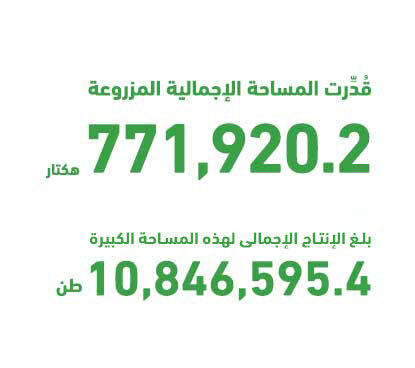
In Saudi Arabia, the total cultivated area for fruits, grains, vegetables (protected and open-field), in addition to fodder, is estimated at approximately 771,920.2 hectares, with a total production of 10,846,595.4 tons.
-
The area cultivated with fruits is estimated at 207,369.8 hectares, producing 2,342,150.2 tons.
-
The area cultivated with grains such as wheat, barley, and others expanded to 262,622.9 hectares, yielding 1,254,966.6 tons.
-
The area of open-field vegetables reached 88,644.2 hectares, with production totaling 2,111,028.5 tons.
-
The area cultivated with fodder crops such as alfalfa and blue panic grass is estimated at 207,387.9 hectares, producing 4,556,663.5 tons.
-
The total production capacity of wheat flour in the Kingdom is 15,150 tons/day, while the total operational capacity of wheat silos in Saudi milling companies equals 745,000 tons.
-
The total production capacity for animal feed in the Kingdom reaches 3,200 tons/day.
-
Total manufactured flour amounted to 2,650,111 tons in 2020.
-
Total manufactured animal feed reached 555,858 tons in 2020.