Mashroo3k Economic Consulting Company offers a feasibility study for a tourism company project in Iraq with the highest return on investment and the best payback period, through a set of accurate studies of the size of the Iraqi market, analyzing the strategies of local and foreign competitors, and providing competitive price offers.

Mashroo3k Economic Consulting Company provides investors wishing to invest in a tourism company project in Iraq with a set of specialized feasibility studies based on updated databases specific to the tourism sector in Iraq, which helps the project succeed, achieve the highest return on investment, and the best payback period, through accurate studies of the size of the Iraqi market, analysis of the strategies of local and foreign competitors, study of potential suppliers, and the possibility of obtaining competitive price offers.

Mashroo3k Company for Economic Consulting is keen to provide a group of technical and accurate marketing studies in the tourism and travel company project, and a marketing team capable of coordinating with customers and users, and innovating new methods to open new markets.
Executive Summary
Study of project services/products
Market Size Study
Risk study
Technical study
Financial study
Organizational and administrative study
The Tourism Sector in the Gulf Cooperation Council (GCC) Countries
One of the most important sectors contributing to the global GDP; its direct contribution constituted 3.3% of the global GDP; and the total contribution of the sector amounted to 10.4%; amounting to 9.2 trillion US dollars. It is worth noting that the sector’s jobs represent 10.6% of all jobs (334 million jobs); and the value of global spending on leisure travel is estimated at about 2.37 trillion US dollars. It is worth noting here that the sector is growing continuously, so much so that it creates one in four new jobs worldwide. This was a brief overview of the global sector indicators
As for the sector indicators in the GCC countries, we will present them as follows:
The total number of tourists arriving in the GCC countries reached 43.8 million tourists, with an annual decline rate of 0.3% over a period of 5 years.
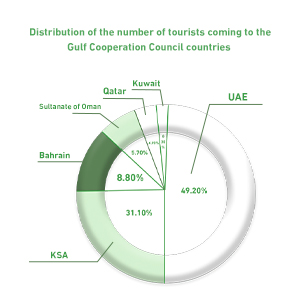
If we assume the number of tourists arriving in the GCC countries as percentages, the UAE alone would have accounted for about 49.2%, followed by Saudi Arabia with 31.1%. As for the rest of the countries, the following figure shows the distribution of the number of tourists arriving in the GCC countries:
Spending by inbound tourists in the Gulf Cooperation Council (GCC) countries recorded consecutive growth of 12.1%, reaching a total of $81.1 billion.

There is no doubt that the COVID-19 pandemic had a significant impact on the decline of global travel and tourism indicators. The sector’s contribution to the global GDP dropped to 6.1%, down from 10.3% in the year prior to the pandemic.
However, the sector has recently begun to recover, as confirmed by global indicators.
For this reason, Mashroo3k strongly recommends investing in this vital sector, based on the following factors: (List of reasons follows).
According to the World Tourism Organization (UNWTO), the number of international tourists increased from 25.2 million tourists in 1950 to 1.40 billion tourists after 68 years.
By the end of 2021, 2,246 hotels were opened worldwide, and by the end of 2022, this number is expected to reach 2,805 hotels, and by the end of 2023, the number of these hotels will reach 2,934 hotels.
340.7 thousand hotel rooms were opened worldwide in 2021, and the number is expected to rise to 428 thousand hotel rooms by the end of 2022, and by the coming of 2023, the number of rooms will reach 447.6 thousand rooms.
Global Tourism Sector
By the end of 2021, the contribution of travel and tourism to global GDP increased by 21.7% compared to the previous year, when the Corona pandemic affected the sector. The value of the sector’s contribution to global GDP amounted to approximately 5.81 trillion US dollars. It is noteworthy that the global tourism market was valued at approximately 1.311 trillion US dollars, and the value of this market is expected to rise to 2.291 trillion US dollars by 2030 (excluding the results of the pandemic year).