
paper recycling plant

Study request

Mashroo3k Economic Consulting Company offers a feasibility study for a paper recycling plant project, with the highest return on investment and the best payback period. This study is based on a series of in-depth studies of the Iraqi market size, an analysis of local and foreign competitors’ strategies, and the provision of competitive pricing.

share capital

Rate of return

Recovery period Second year

Paper Recycling Plant Description

Paper Recycling Plant Description

The paper recycling plant recycles used and damaged paper waste using the latest machinery and equipment, producing new paper raw materials suitable for a variety of uses. The project targets a variety of institutions, such as pharmacies, health centers, cleaning companies, clinics, and hospitals.

Experts at Mashroo3k Economic Consulting Company indicate that the paper recycling plant is one of the projects witnessing significant growth in Iraq, especially in light of reconstruction and infrastructure rehabilitation policies, and environmental protection from the damage caused by waste accumulation or incineration. Paper recycling projects contribute to reducing demand for raw materials, achieving high economic returns, and reducing the unemployment rate, which has witnessed a significant increase in Iraq in recent years.

Mashroo3k Economic Consulting provides investors interested in investing in a paper recycling plant project in Iraq with a range of specialized feasibility studies based on up-to-date databases specific to the Iraqi market. These studies help ensure the project’s success, achieve the highest return on investment, and provide the best payback period. These studies are conducted through thorough studies of the Iraqi market size and customer preferences, analysis of local and foreign competitors’ strategies, and the ability to provide competitive pricing.

Advantages of a Paper Recycling Plant

Advantages of a Paper Recycling Plant

Mashroo3k Economic Consulting Company ensures that the paper recycling plant project has the latest production lines, advanced recycling and re-production technology, and a fully operational team characterized by its ability to innovate and renew. This is in addition to numerous recommendations from your project consultants to enhance the project’s competitive advantages and how to shorten the path to achieving the highest return on investment.

Mashroo3k Economic Consulting Company directs investors wishing to invest in a paper recycling plant project, or develop their existing projects, to seek the advice of specialized consultants through Mashroo3k company, to help them determine the best methods and approaches for developing the plant’s products and enhancing its competitive advantages.

Paper Recycling Plant Products

Paper Recycling Plant Products

  • Pocket Tissues
  • Paper Napkins
  • Scented Tissues
  • Bathroom Tissue
  • Facial Tissues
  • Kitchen and Toilet Rolls
  • Car Tissue Packs
  • Paper Towels
  • Sanitary Tissues
  • Wet Tissues
  • Specialty Tissues and Rolls
Why Mashroo3k ?

Why Mashroo3k ?

  • Mashroo3k has over 11 years of experience in preparing feasibility studies, conducting market research, and providing comprehensive consulting services.
  • Mashroo3k has offices in 7 international branches, located in Saudi Arabia, the UAE, Egypt, Qatar, Oman, Yemen, and Iraq, in addition to its agents in China, Singapore, and other countries.
    Having delivered over 7,000 feasibility studies, Mashroo3k has helped thousands of clients achieve their investment goals.
  • Mashroo3k’s services are accredited and trusted by all financial institutions and funding entities across the Middle East.
  • The company’s geographic reach spans 35 countries across all continents.
  • Mashroo3k holds membership in over 100 prestigious international organizations specializing in market research and business management.
  • Its team consists of 350 consultants with deep expertise in promising economic sectors, ensuring tailored solutions and strategies that meet clients’ needs.
  • Mashroo3k is partnered with more than 10,200 suppliers across 22 countries, providing logistical support for projects, including production lines, raw materials, machinery, and equipment.
  • With an extensive database, Mashroo3k enhances the accuracy of its forecasts and analyses, strengthening its risk management capabilities.
  • Project Features
  • Study Contents
  • Sector indicators
  • The project as an investment opportunity
مؤشرات القطاع
  • Environmental conservation.
  • Contributing to meeting part of the growing demand for various types of tissue paper.
  • Creating new investment opportunities with good returns.
  • Achieving a good return for the project owner.
  • Achieving good returns, cash flows, and added economic value.
  • Optimal use of resources and assets.
  • Providing high-quality products.
  • Maintaining a price level that enables the project to achieve its target share.

Executive Summary

  • About the project
  • Financial indicators
  • Justifications for establishing the project
  • Government investment incentives in the project field
  • Target Markets
  • Project indicators and final results

Study of project services/products

  • Study of project services/products
  • Description of the project and all its products/services

Market Size Study

  • Familiarity with distribution channels
  • Consumer behavior, desires and nature
  • Competitors’ products or services, and what their strengths and weaknesses are.
  • Nature of the market and its characteristics
  • The volume of demand for the product or service provided
  • Available share of target market
  • The best way to market

Risk study

  • Identify risks
  • Impact of risks on the project
  • Risk prevention methods
Technical study
  • Detailed description of project products Expected production capacity Determination of investment costs
  • Determine the volume of electrical energy and water
  • Determine the project’s labor needs
  • Determine project requirements
  • Construction and building cost calculation
  • Total Capital Calculation
  • Determine annual operating costs
  • Determine the amount of working capital
Financial study
  • Total investment costs required for the project
  • Organizing the cash flow and income statements as well as the financial position statement for the first ten years of operation.
  • Determine the expected annual revenues of the project in light of the specified operational capacities.
  • The optimal financing structure for the project in light of the investors’ capabilities and in light of the financing granting conditions
  • Project financial indicators and sensitivity analysis
Organizational and administrative study
  • Project manpower
  • Organizational structure
  • Job Duties
المشروع كفرصة استثمارية

The Recycling Sector in the Gulf Cooperation Council (GCC) Countries

Technological advancements in the Gulf Cooperation Council (GCC) countries, along with population growth, have led to an increase in the volume of waste generated from human, industrial, and other activities. This growing waste problem has posed a real challenge for GCC governments, requiring them to act swiftly to mitigate environmental and health risks. The total collected waste (both hazardous and non-hazardous) in GCC countries is estimated at approximately 131.8 million tons, with 1.2% classified as hazardous waste and 98.8% as non-hazardous waste.

Key Indicators of the Recycling Sector in the GCC:

  • The total collected hazardous waste in GCC countries amounts to 1.6 million tons.
  • The total collected non-hazardous waste in GCC countries amounts to 2 million tons.
  • Hazardous waste is categorized as follows: 6% medical waste, 81.8% industrial waste, and 12.2% other waste (such as batteries and electronic waste).
  • Non-hazardous waste is categorized as follows: 40.7% construction waste, 25% household waste, 1.7% green waste, and 32.5% other waste.
  • 51% (67.2 million tons) of the total collected waste has been processed.
  • The total collected industrial waste in GCC countries is 1.3 million tons, with Saudi Arabia and the UAE generating 63.1% and 19.3% of this waste, respectively.
  • The total collected non-hazardous household waste in GCC countries is 32 million tons.
  • The UAE ranks first in terms of recycled waste, accounting for 42.8% of total processed waste.
  • The amount of hazardous waste recycled in GCC countries is 100,000 tons (9.3%) of the total processed hazardous waste.
  • Saudi Arabia leads in solid waste production, generating over 16 million tons annually, followed by the UAE with 5.4 million tons annually.

Waste Composition in the Middle East and North Africa (MENA) Region:

  • Food and green waste: 58%
  • Glass: 3%
  • Metals: 3%
  • Paper and cardboard: 13%
  • Plastic: 12%
  • Wood: 1%
  • Rubber and leather: 2%
  • Other waste: 8%

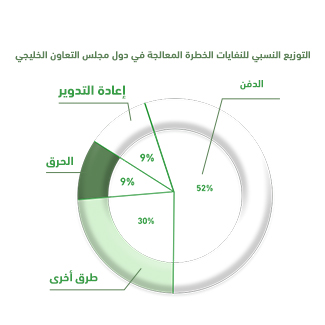
Waste Treatment in the GCC:

  • Hazardous waste treatment methods:

    • Incineration: 9%
    • Landfilling: 51.7%
    • Recycling: 9.3%
    • Other methods: 30%
  • Non-hazardous waste treatment methods:

    • Landfilling: 51%
    • Other methods (incineration, recycling, etc.): 49%

Benefits of the Circular Economy in GCC Countries:

  • Reducing primary energy consumption by approximately 4%.
  • Creating 50,000 jobs in the recycling sector.
  • Reducing CO₂ emissions by 13 million tons annually.
  • Contributing to economic returns of up to USD 138 billion for GCC countries between 2020 and 2030.

Recommendations:

Mashroo3k Consulting recommends investing in the recycling sector due to the following factors:

  • Global municipal solid waste production is approximately 2.01 billion tons and is expected to reach 3.40 billion tons by 2050.
  • In 2014, global e-waste production reached 12.8 million metric tons, rising to 53.6 million metric tons by 2019.
  • Plastic and paper account for approximately 29% of global waste, making them highly profitable sectors for recycling investment.

Below is a breakdown of global waste types and their percentage share of total waste production:
 
 
مؤشرات المشروع

Saudi Arabia’s Recycling Sector: A Profitable Investment Opportunity

Mashroo3k Consulting confirms that Saudi Arabia now generates over 45 million tons of waste annually. With the kingdom aiming to increase its recycling rate from 1% to 80% by 2035, the company believes that investing in this vital sector will be highly profitable.

Future Prospects for Recycling and Energy Production in Saudi Arabia

  • Recycling glass and metals alone could save 45,000 terajoules of energy annually in Saudi Arabia.
  • If all food waste in Saudi Arabia were processed in biogas plants, the country could generate 3 terawatt-hours of electricity per year.
  • By processing plastic and other mixed waste (such as paper, cardboard, wood, textiles, leather, etc.) through pyrolysis, Saudi Arabia could produce between 1 and 1.6 terawatt-hours of electricity annually.

Mashroo3k Consulting emphasizes that recycling is one of the most promising sectors in Saudi Arabia. With the kingdom’s commitment to a green economy and Vision 2030 prioritizing environmental preservation, recycling projects present real investment opportunities.

The Global Recycling Industry

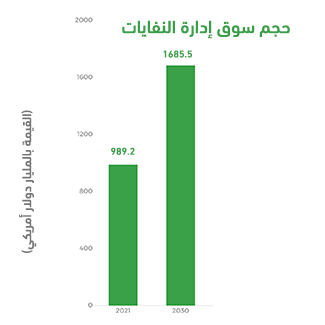
  • The global waste management market was valued at $989.2 billion in 2021.
  • It is expected to expand at a CAGR of 6.2% from 2022 to 2030, reaching a market value of $1.685 trillion by 2030.
  • The Middle East and North Africa (MENA) region is projected to see a CAGR of 6.3% in recycling and waste management between 2022 and 2030.
  • This growth is driven by increasing awareness of the sustainable benefits of recycling and reusing waste.
  • Population growth, urbanization, economic expansion, and evolving consumption patterns are key factors that necessitate investment in this critical sector.
 

By sector


share capital(By the million)


Rate of return


  • Similar projects

Similar projects

Electrical wire recycling plant

share capital

Rate of return

Study request

plastic recycling plant

share capital

Rate of return

Study request

car oil recycling plant

share capital

Rate of return

Study request

paper recycling plant

share capital

Rate of return

Study request